Privacy by Design: How ZTmail Protects User Privacy
Building the Security Architecture for Intelligent EmailSeptember 20, 2026
Privacy protection is not a feature that should be added after a product has been designed. For ZTmail, it is part of the reason the platform exists. From the beginning, the company brand name – ZoTrus came from zero trust, it has represented a commitment to treating privacy as a fundamental security boundary rather than as a statement made only in a policy document.
Email is essential to everyday life, education, and business, but it also carries identity information, contracts, financial records, confidential discussions, and details about personal and professional relationships. Protecting privacy therefore requires more than securing the message while it is in transit. It requires architecture that limits unnecessary data collection, keeps cryptographic authority with the appropriate party, and provides automation without turning convenience into centralized custody.
This article does not restate ZTmail’s formal privacy terms. Instead, it explains the architectural and operational decisions through which ZTmail seeks to protect user privacy in practice.
1. Making Encryption Automatic at the User Endpoint
Much of the information exchanged through email is traditionally stored as readable content on mail servers. Transport encryption such as TLS can protect a connection while a message is moving between systems, but it does not by itself ensure that the message remains encrypted after it reaches a mail server, a backup system, or another storage environment. If the message is stored in plaintext, anyone who gains inappropriate access to the relevant mailbox or server may be able to read it.
Privacy concerns do not end with message content. For many email services, reading users’ email and displaying targeted advertising has become a major revenue model, while the growing use of email data and user interactions for AI training introduces another important question: how much of a user’s private information should a service provider be able to access, retain, or reuse?
ZTmail was created to address this gap by making S/MIME encryption practical and automated at the user endpoint. The objective is not to ask users to remember a manual encryption procedure for every sensitive message. It is to make signing, encryption, decryption, certificate handling, and verification part of the normal email workflow.

The user’s email is protected with the appropriate public keys, and the resulting encrypted message remains within the user’s own email server. ZTmail does not need to retain a readable copy of the user’s mail in its cloud merely to provide automated encryption, the encryption is done by ZTmail App in user’s device, not in the cloud.
Automation matters because privacy protection that depends entirely on manual discipline will be applied inconsistently. By making S/MIME operations part of the normal email experience, ZTmail reduces avoidable mistakes while preserving user control over the underlying cryptographic material. And the emails are stored in encrypted form on the user's mail server, effectively preventing anyone other than the user from reading the private information in emails.
2. Deliberately Not Providing a Public-Key Exchange Service
At an early stage, ZTmail considered public-key exchange to be one of the main barriers to wider email encryption. In a conventional S/MIME workflow, the sender needs the recipient’s public certificate before an encrypted message can be prepared. This appears to create a need for a certificate directory that can locate a recipient’s certificate before a message is sent.
Further evaluation, however, showed that a centralized public-key lookup service could expose sensitive metadata about communication relationships. A service that records which sender is searching for which recipient’s certificate could potentially reveal who is preparing to communicate with whom, which organizations are connected, or which recipients a user is contacting on a particular day. Even without message content, this relationship data can itself be private.
For that reason, ZTmail deliberately decided not to provide a centralized public-key exchange service. This is a privacy-oriented architectural decision: it avoids creating a new central observation point for users’ communication patterns when the technical problem can be addressed through ordinary email interaction.
The practical obstacle is also less absolute than it first appears. When a user sends a digitally signed S/MIME email, the sender’s public certificate can be included with the message. After the recipient receives the signed message, the email client can extract the public certificate and store it locally. When the recipient later replies with an encrypted message, the locally available certificate can be used without a prior lookup through a third-party directory.
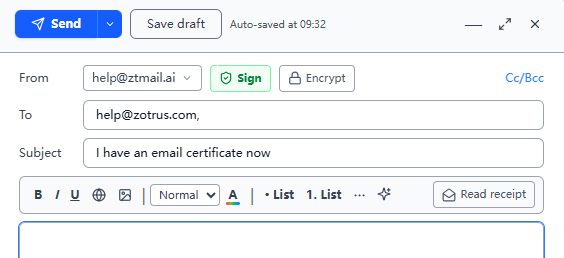
The parties already have a reason to communicate by email. A signed message can carry the public certificate needed for subsequent encrypted communication, allowing certificate exchange to occur as part of normal correspondence without requiring ZTmail to operate a service that observes certificate-search activity.
3. No Key Escrow, But Automated Key Management
A user’s cryptographic keys are among the most sensitive assets associated with encrypted email. A private key enables the user to decrypt protected correspondence and preserve access to historical encrypted messages. Whoever controls that key may possess the practical ability to access information that encryption was intended to protect.
ZTmail therefore does not position itself as a key-escrow provider that takes custody of readable user keys for the S/MIME automation service. ZTmail’s cloud services can provide certificate automation and trusted CA connectivity without requiring ZTmail to maintain a readable copy of a user’s private key or to become the holder of the user’s decryption authority.
At the same time, simply telling users to manage every backup, export, migration, and recovery task on their own would not be responsible. Manual key management is error-prone, especially when users change devices, reinstall operating systems, migrate email clients, or need to open messages encrypted years earlier.
ZTmail’s solution is to provide automated key-management functions without turning them into key custody. Relevant certificate and private-key material are packaged into an encrypted backup archive and automatically stored in the user’s own mailbox rather than uploaded as readable key material to a ZTmail-controlled repository. The mailbox provides storage and synchronization, while the backup remains encrypted.
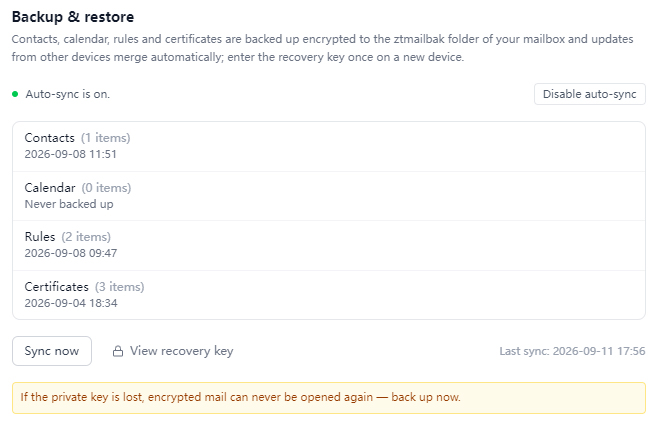
The user remains responsible for protecting the Recovery Key needed to unlock the archive. ZTmail automates the work of creating, updating, storing, and retrieving the backup, but it does not assume ownership of the secret that grants access to the protected material.
4. No Centralized Address-Book Backup, But User-Controlled Automatic Synchronization
Address books are more than convenience data. They can reveal customers, suppliers, colleagues, family members, partners, professional relationships, and organizational structure. Calendars can reveal meetings, travel plans, project schedules, and sensitive business activity. Mail-sorting rules may also expose how a user classifies and prioritizes communications.
Many services automatically synchronize this information to the provider’s cloud because centralized storage makes multi-device access easier. The convenience is real, but the model can create a persistent collection of personal relationship data outside the user’s direct control.
ZTmail does not provide a centralized address-book backup service in which users’ contacts are routinely copied into a ZTmail-controlled cloud. At the same time, refusing to provide any synchronization mechanism would be impractical. Users who carefully organize contacts, calendars, and mail-sorting rules on one device should not have to recreate that work on every other device.
ZTmail therefore applies the same privacy-oriented backup model used for certificate and private-key material. Contacts, calendars, and mail-sorting rules can be included in an automated backup package and stored in the user’s own mailbox rather than in ZTmail’s cloud. The user’s mailbox becomes the user-controlled backup data’s synchronization channel.
This approach balances privacy and usability. The service provider does not automatically accumulate a separate cloud copy of the user’s address book and relationship graph, while the user can still move to another device and recover the working environment. Automation reduces repetitive work without silently expanding the amount of personal information held by the platform.
5. Outsourcing Identity Validation to Specialized Providers
Some ZTmail paid services, including the Trusted Identity Edition and the Global Ecosystem Edition, depend on identity validation. These services may require validated information about an individual, an organization, or the relationship between them so that an S/MIME certificate can express an appropriate level of identity assurance.
Identity validation is a specialized activity with operational, regulatory, security, and data-protection requirements. Rather than building a broad identity-validation operation inside ZTmail and collecting large amounts of identity evidence directly, ZTmail follows a data-minimization principle and uses specialized professional providers for the validation process.
Under this model, a professional identity validation provider performs the relevant identity checks, such as individual validation for an IV certificate. The specific provider or providers may vary by market and service arrangement. ZTmail has evaluated the appropriate specialized multi-providers for worldwide customers.
ZTmail should not retain unnecessary identity-proofing materials or raw personal identity data, such as identity-document numbers, simply because a user has completed validation. Instead, it needs only the identity information required for the resulting certificate and service operation, such as the validated individual name and organization name that must appear in the identity certificate.
This separation reduces the amount of sensitive identity evidence ZTmail itself needs to collect and retain. Specialized providers perform identity validation, while ZTmail uses the resulting validated identity attributes for the cryptographic certificate and trusted-identity experience.
6. Privacy Protection Is an Architectural Commitment
The privacy model described here is not based on a single feature. It is the combined result of several decisions: make S/MIME encryption automatic at the user endpoint; avoid operating a centralized public-key exchange service that could reveal communication relationships; do not take custody of readable private keys; automate encrypted backup while leaving recovery authority with the user; avoid creating a centralized cloud copy of address books and related personal data; and use specialized providers for identity validation while applying data minimization to retained information.
These choices reflect a consistent distinction between automation and ownership. ZTmail seeks to automate the work required to make cryptographic email practical, but automation should not require the platform to collect everything, observe everything, or control every secret. A system can provide synchronization without becoming the owner of a user’s contact graph. It can provide certificate services without holding readable private keys. It can support validated identity without retaining every piece of identity evidence used during validation.
For ZTmail, privacy protection is therefore not limited to preventing unauthorized access to message content. It also means reducing unnecessary data collection, avoiding avoidable metadata exposure, preserving user control over cryptographic authority, and designing cloud services so that convenience does not automatically become centralized custody.
The next generation of email security will combine cryptography, automation, and user experience so that trust is no longer assumed, but verified throughout the communication lifecycle. This is the direction ZTmail is committed to advancing: making privacy personal or organizational and protected.
Click here to read PDF edition (digital signature and timestamp with global trust and global legal effect, all rights reserved, plagiarism is prohibited! Please indicate when reprinting: Reprinted from ZoTrus CEO Blog)